Friday, November 17, 2006


10 Clouds

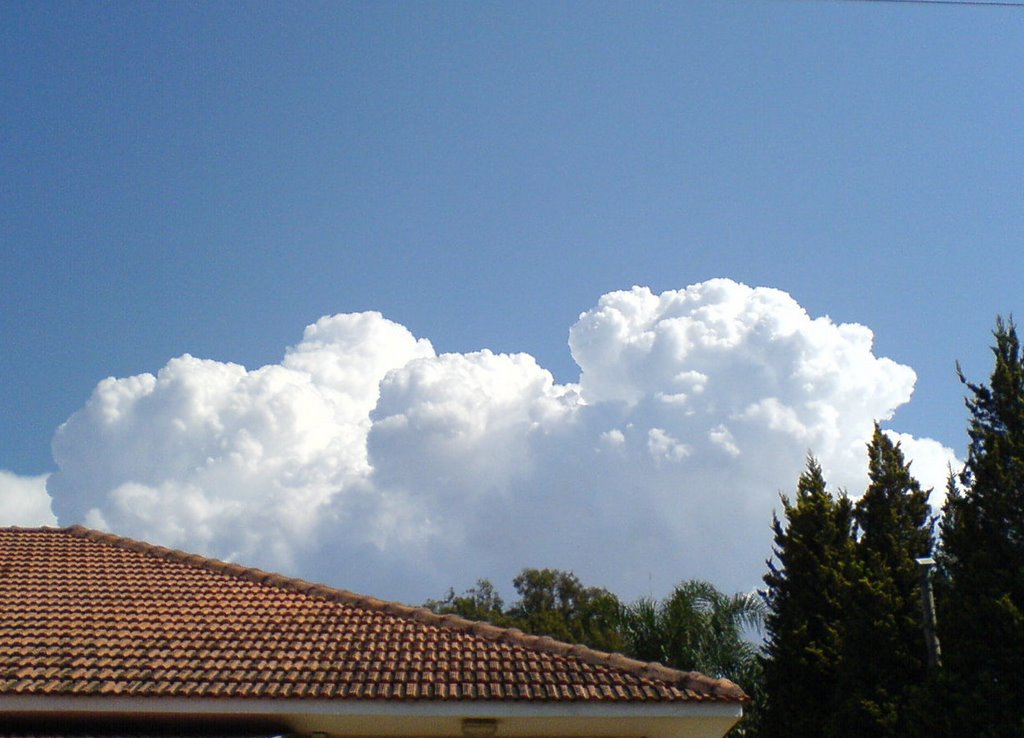
Since the days I used to fly thru the clouds I especially like the cumulonimbus clouds that develop vertically, when they do not blanket the entire sky and it is possible to see clearly their straight base and their shooting peaks in varying formations. Next to their brilliant whiteness, the sky seems all the more blue. Our skies are free of clouds a large part of the year, and in the summer the sun is so strong that it seems as if the sky is white.
The development of the cumulonimbus clouds is somewhat difficult to ascertain from the ground, and commercial airplanes fly rapidly above them to steady themselves at high altitude, from where the clouds look like an ambiguous carpet. But when you fly at cloud level – their vertical development can extend thousands of feet – the large clusters resemble gigantic cotton mountains, and the sun shinning above them gives these clouds a plastic quality that creates the illusion that they are made of solid matter. Flight between masses of such clouds in a small swift plane that enables observation of their forms – to climb above them and then dive in between them – is an experience that defies description. It is a long time already since I flew a plane, and I do not miss the experience generally. But when I see these clouds in the sky, the desire to fly to them and through them, overcomes me. Look at them above the tile roof and the tops of the cypress trees, they look like whipped cream. They send me greetings from long ago and I smile at them in return.

Thursday, November 09, 2006


9 The Road to Benyamina

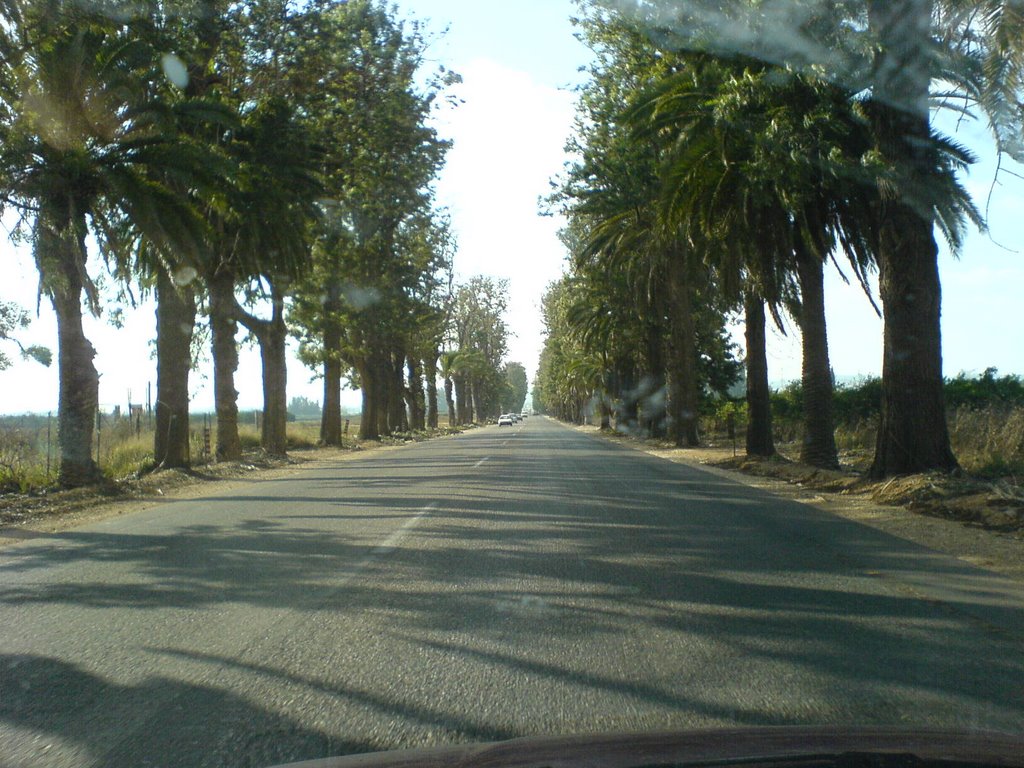
The road between Pardes Hannah and Benyamina is a time tunnel to me. On entering it, with the trees on both sides, light and shade hit my eyes alternately, and for a moment it seems as if I have returned to the Israel of my youth – a time when the plains were blanketed with orange groves that were usually fringed with fir trees and every little path wound its way lined by trees. I remember, for example, the huge eucalyptus trees along the road between Gedera and Hazor junction. Today it is a wide two-lane road but in my imagination it is still the same narrow road on which I walked in the shade of the trees holding my violin on my way home. A few years ago, in Ile de France and Normandy, I saw vast fields crossed by narrow lanes lined with shade trees that could be seen from a distance. In Israel, the rows of trees along the roads have almost completely disappeared. When the orange groves disappeared, the rows of fir trees disappeared with them. The sabra (cactus) fences to which we used to go in order to pick the sweet fruit disappeared long before (Just writing about sabras causes my palms to "feel" their thin fuzzy thorns).
Thus the road to Benyamina represents a little treasure from the past. It is a reminder of times gone by. It is impossible to stop development and broad roads are a necessity. Nevertheless it makes me sad to see that every new road is the end of a beautiful line of trees. Every time I go on the road to Benyamina I am thankful that the road, with the trees on its sides, still exists.

Thursday, November 02, 2006


8 Tel Aviv before Sunset

The most beautiful hour is the hour before sunset. Once a week I manage to view the streets and houses of Tel Aviv at this magic hour of gently slanting sunlight. Opposite them electric lights already shine and the windows sparkle either because of the sunlight or because of the electric lights in the houses and offices. Tel Aviv is fascinating because of its combination of old and new. The skyscrapers which are shooting up so quickly there give her an aspect of power and audacity. Its horizon somewhat resembles that of large modern cities. For example, the entrance to Tel Aviv from the north in the evening is entrance into a metropolis. I regard the concentration of houses near the Diamond Exchange, look at the Azrieli Towers and the Government Administration Center. Such observation enables me to feel the pulse of the city that finds expression in this architectural "explosion".
However, at the heart of the city and close to these self same symbols of power, are many old houses – some of whom are beautiful. Sometimes the combination of the ultra-modern and the noble modesty of the old create a unique beauty. In the center of the photo we see an old tile roof, a strange drainpipe, and a protruding porch of an old house. Notice how all this balances all that is new in the background. Remove the old and the result is an uninteresting modern city scene. However, if you remove the background, the result is merely an old house whose tile roof is about to fall apart. But together they create the marvel which is Tel Aviv in her finest hour.

Thursday, October 26, 2006


7 What we were

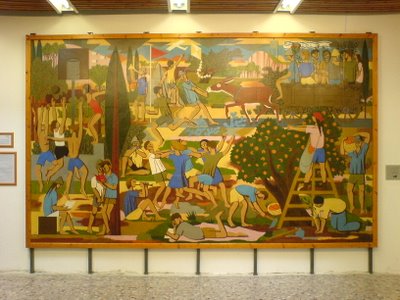
Look at the fresco by Yohanan Simon which is now in Kibutz Gan Shmuel's dinning hall. Formerly it was part of the "Renaissance" School in Sao Polo, Brazil. The wall has been demolished but the parts of the wall on which the fresco was painted were carefully collected, restored by experts and reconstructed in the Kibutz that inspired it. The style is naive and optimistic, almost childish, and expresses all the hopes of the early l950's (it was painted in l954) not long after the establishment of the state of Israel. At that time kibutz youth (the fresco's subject) were a source of pride and were seen by many as the symbol of the new state.
Look at the children playing, working, making music, dancing. Look at them reading books, planting trees, picking oranges and waving flags. Look at the light and the joyous activity enfolding them all and think of what was here not long ago. What grand hopes, what joy.
If today this painting seems a little childish, perhaps because unlimited optimism and exuberant joy we keep for children's rooms and outside of them we put on a grey mask of stubborn strength that shows no trace of a smile. This painting from a period of great hopes reminds us of what we were and what we still may become.

Thursday, October 19, 2006


6 Haruvim Street

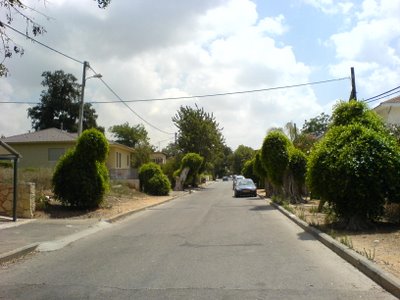
This is Haruvim (Carob) Street, the street on which I live. Indeed there are a few Carob trees on it, but the street's main attraction are the gigantic Ficus trees that once made an impressive green canopy over the road. When I came to Pardes Hana looking for a house to live in, I walked under the magical trees and fell in love with the street. It is in an ideal location, within walking distance of the town's center, post office, banks, "Hagoren" (The Barn) bakery and the Central bus station. Lately this has been closed and is now an asphalt wasteland and an environmental eyesore since it has been turned into a weekly market every Thursday, with terrible traffic jams and cars parked the length and width of the entire area. Aside from the excellent location, the trees transformed the street into a little corner of a dream. As you walked under the canopy of the gigantic trees, with the dimness created by the lofty branches, you realized that you had left the world of thorns, weeds and shade less earth of large parts of the surrounding country side behind, and felt that suddenly you were in another world in which ancient gigantic trees rest contentedly over peaceful streets and houses. Nirvana.
But all that is only a vanished dream. Considerations which I find hard to justify, overcame the dream and the beauty. The saw came and in a single day cut down the street's pride and glory. The trees will grow again, perhaps, but many years will pass before the street will regain its former beauty, if at all. And that is a shame.

Wednesday, October 11, 2006


5 Swimming - then and now

This is my swimming pool. That is to say the pool I swim in summer and winter – 40 lengths and now with Training Fins even 50–60. I swim three styles very well. Once I was an excellent swimmer.
Yes, once I was the regional breast stroke champion in a tough region that included, among others, strong teams of Na'an, Giv'at Brenner, Kvutzat Schiller, Hatzor and Kfar Menachem. And one summer I even trained with Romania's butterfly swimming champion. He was in our Ulpan and took upon himself the training of our swimming team. Just imagine, one summer we were champions in the prevailing communist style – personal discipline and hard work. But what I learned from Karol when I was l4–l5 years old, I never forgot. For instance, that with professional training and hard work there is no limit to what can be achieved. Only two violin teachers taught me more than that, but that is another story.

Wednesday, October 04, 2006


4 I like coffee

I like coffee – at least two cups a day – prepared in a Bialti Brikka Espresso Maker, and sometimes by placing a simple filter on the cup, if I want the coffee as a hot drink and not as a concentrated one. I buy my coffee at the coffee shop in Gan Shmuel Center – 500 gram of "Coffee of the House" to which I add 100 gram of a kind of coffee beans that add a deeper color and coarser texture. I grind the coffee beans in a simple knife grinder (the experts use a coffee mill) just before using them.
I like the smell of the coffee and enjoy the process of preparing it. I once received a present of an expensive Espresso Machine, but decided to do without it, because I could not part with my Brikka. I can hardly bear instant coffee and I always wonder how so many Israelis abroad long for this insipid instant coffee they became accustomed to in their youth. To my joy, the coffee culture has developed considerably in the past decade. I noticed this revolution when I worked in Tel Aviv near "Ilan's Café" and "Café Joe", and would stop by often to be amazed at the remarkable variety and the intoxicating aroma, as well as by new ways of preparing coffee. On my way home from the swimming pool I briefly park my motorcycle next to the coffee house and return home with two bags of the black treasure whose taste is heaven.