Thursday, November 02, 2006


8 Tel Aviv before Sunset

The most beautiful hour is the hour before sunset. Once a week I manage to view the streets and houses of Tel Aviv at this magic hour of gently slanting sunlight. Opposite them electric lights already shine and the windows sparkle either because of the sunlight or because of the electric lights in the houses and offices. Tel Aviv is fascinating because of its combination of old and new. The skyscrapers which are shooting up so quickly there give her an aspect of power and audacity. Its horizon somewhat resembles that of large modern cities. For example, the entrance to Tel Aviv from the north in the evening is entrance into a metropolis. I regard the concentration of houses near the Diamond Exchange, look at the Azrieli Towers and the Government Administration Center. Such observation enables me to feel the pulse of the city that finds expression in this architectural "explosion".
However, at the heart of the city and close to these self same symbols of power, are many old houses – some of whom are beautiful. Sometimes the combination of the ultra-modern and the noble modesty of the old create a unique beauty. In the center of the photo we see an old tile roof, a strange drainpipe, and a protruding porch of an old house. Notice how all this balances all that is new in the background. Remove the old and the result is an uninteresting modern city scene. However, if you remove the background, the result is merely an old house whose tile roof is about to fall apart. But together they create the marvel which is Tel Aviv in her finest hour.

Thursday, October 26, 2006


7 What we were

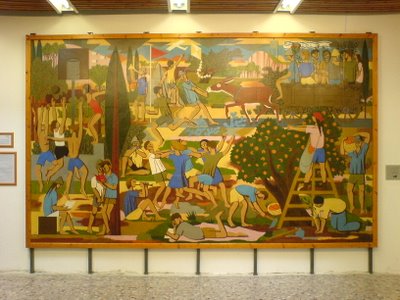
Look at the fresco by Yohanan Simon which is now in Kibutz Gan Shmuel's dinning hall. Formerly it was part of the "Renaissance" School in Sao Polo, Brazil. The wall has been demolished but the parts of the wall on which the fresco was painted were carefully collected, restored by experts and reconstructed in the Kibutz that inspired it. The style is naive and optimistic, almost childish, and expresses all the hopes of the early l950's (it was painted in l954) not long after the establishment of the state of Israel. At that time kibutz youth (the fresco's subject) were a source of pride and were seen by many as the symbol of the new state.
Look at the children playing, working, making music, dancing. Look at them reading books, planting trees, picking oranges and waving flags. Look at the light and the joyous activity enfolding them all and think of what was here not long ago. What grand hopes, what joy.
If today this painting seems a little childish, perhaps because unlimited optimism and exuberant joy we keep for children's rooms and outside of them we put on a grey mask of stubborn strength that shows no trace of a smile. This painting from a period of great hopes reminds us of what we were and what we still may become.

Thursday, October 19, 2006


6 Haruvim Street

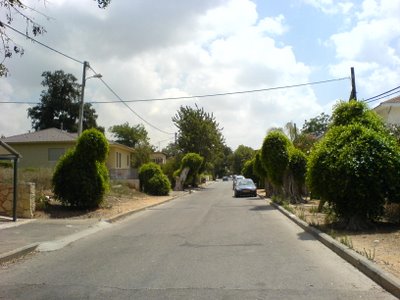
This is Haruvim (Carob) Street, the street on which I live. Indeed there are a few Carob trees on it, but the street's main attraction are the gigantic Ficus trees that once made an impressive green canopy over the road. When I came to Pardes Hana looking for a house to live in, I walked under the magical trees and fell in love with the street. It is in an ideal location, within walking distance of the town's center, post office, banks, "Hagoren" (The Barn) bakery and the Central bus station. Lately this has been closed and is now an asphalt wasteland and an environmental eyesore since it has been turned into a weekly market every Thursday, with terrible traffic jams and cars parked the length and width of the entire area. Aside from the excellent location, the trees transformed the street into a little corner of a dream. As you walked under the canopy of the gigantic trees, with the dimness created by the lofty branches, you realized that you had left the world of thorns, weeds and shade less earth of large parts of the surrounding country side behind, and felt that suddenly you were in another world in which ancient gigantic trees rest contentedly over peaceful streets and houses. Nirvana.
But all that is only a vanished dream. Considerations which I find hard to justify, overcame the dream and the beauty. The saw came and in a single day cut down the street's pride and glory. The trees will grow again, perhaps, but many years will pass before the street will regain its former beauty, if at all. And that is a shame.

Wednesday, October 11, 2006


5 Swimming - then and now

This is my swimming pool. That is to say the pool I swim in summer and winter – 40 lengths and now with Training Fins even 50–60. I swim three styles very well. Once I was an excellent swimmer.
Yes, once I was the regional breast stroke champion in a tough region that included, among others, strong teams of Na'an, Giv'at Brenner, Kvutzat Schiller, Hatzor and Kfar Menachem. And one summer I even trained with Romania's butterfly swimming champion. He was in our Ulpan and took upon himself the training of our swimming team. Just imagine, one summer we were champions in the prevailing communist style – personal discipline and hard work. But what I learned from Karol when I was l4–l5 years old, I never forgot. For instance, that with professional training and hard work there is no limit to what can be achieved. Only two violin teachers taught me more than that, but that is another story.

Wednesday, October 04, 2006


4 I like coffee

I like coffee – at least two cups a day – prepared in a Bialti Brikka Espresso Maker, and sometimes by placing a simple filter on the cup, if I want the coffee as a hot drink and not as a concentrated one. I buy my coffee at the coffee shop in Gan Shmuel Center – 500 gram of "Coffee of the House" to which I add 100 gram of a kind of coffee beans that add a deeper color and coarser texture. I grind the coffee beans in a simple knife grinder (the experts use a coffee mill) just before using them.
I like the smell of the coffee and enjoy the process of preparing it. I once received a present of an expensive Espresso Machine, but decided to do without it, because I could not part with my Brikka. I can hardly bear instant coffee and I always wonder how so many Israelis abroad long for this insipid instant coffee they became accustomed to in their youth. To my joy, the coffee culture has developed considerably in the past decade. I noticed this revolution when I worked in Tel Aviv near "Ilan's Café" and "Café Joe", and would stop by often to be amazed at the remarkable variety and the intoxicating aroma, as well as by new ways of preparing coffee. On my way home from the swimming pool I briefly park my motorcycle next to the coffee house and return home with two bags of the black treasure whose taste is heaven.

Saturday, September 30, 2006


3 The Synagogue and the Secular State

Lately, in connection with my work, I had the opportunity to observe the subject of the constitution that was proposed in Israel's early years but never adopted. Especially the role of the public religious leaders, who in the beginning were in the forefront of the advocates of this proposal but afterwards changed their minds, and to this day are reputed to be the ones responsible for the endeavor's failure. The argument about the constitution became intense when all the parties involved in drafting the constitution began to regard it not only as a minimal plan for regulating life in the state and government practices, but as an ideological-educational instrument to impose a world outlook. When matters reached this point, there was no way to bridge the gap between secularists and the religious. Afterwards many in the religious community regretted this, because the arrangements in the constitution that could have been finalized remained unresolved, and only the famous status quo that everyone used in an attempt to gain some advantage, remained as a defense of "religious achievements" in public life.
I am reminded of this when I think of the one day in the year on which the entire Jewish community agrees – today more than ever – that it should act (in public) according to Jewish religious practice. People who the entire year are accustomed to spend their Shabat (Sabbath) going to the sea, shopping in the shopping centers, going on trips or watch soccer games do not protest (and most of them accept willingly) this special day on which traffic on the roads ceases and the world seems to stop for a long 24 hours. One day is not much in comparison with secular life all year, but then again it is not little. This is so mainly because of the conciliatory spirit in which those who have distanced themselves from the synagogue and Yom Kippur practices, receive the holiday.
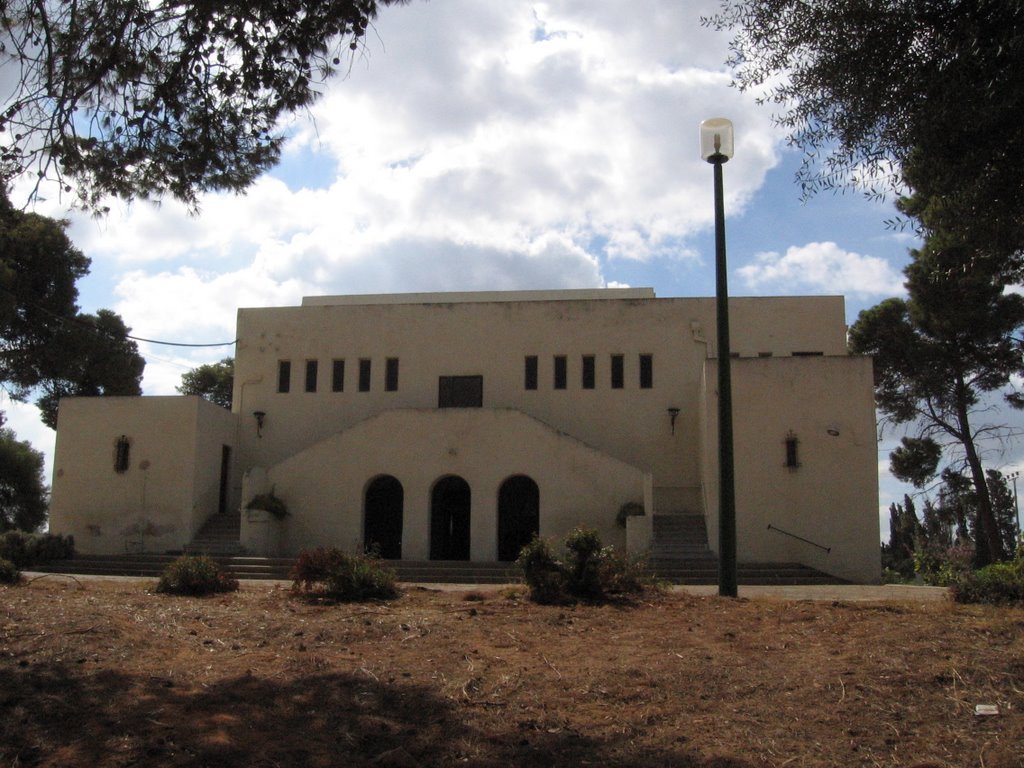
Here is the synagogue. Soon, on the evening of Yom Kippur, it will be filled to capacity. Gmar Chatima Tova.


Wednesday, September 27, 2006


2 "Happy New Year" greetings of long ago

Once upon a time, before singing New Year's cards with moving parts popped up on computers, before text messages and songs were transmitted to our mobile phones, and even the telephone was a rarity – hand written mail would come to every town (a children's song tells about the red mail van arriving today) and connect us to the rest of the world. People wrote letters with pens, and when the holiday arrived everyone sent "Happy New Year" greetings. The city streets teemed with stalls selling thousands of greeting cards sprinkled with gold and silver, with pictures of children or soldiers, with tanks or flowers.
These greeting cards were characterized primarily by naivety, hope and a fervent wish that the new state would be a new beginning and would overcome memories of the past. Here we see children walking in the fields hand in hand. Their figures are disproportional large and it seems as if they are floating. The simple houses and the water tower indicate the new settlement. All around it are green areas and bare hills that are awaiting "Keren Kayemet L'Israel" forestation projects. There are no others to share the land with and no sign of an old village. This is a picture of national rebirth on virgin soil – the essence of the image of an empty country absorbing gladly the children of the dream, its redeemers.
The picture exudes innocence and hope. This is a "Happy New Year" of harmony with friendly nature, of faith in the children's future and the hope that the children (to whom the staff has been passed) will create a new world – the young state of Israel.